Practical guidance on costing and quoting.
Everything here is built on the ten foundations we look for in every estimating process. Start with a pillar, or read the full guide online.
- 01
Capture and encode line items and project components accurately
Ensure that take-offs, products, services, treatments, options, quantities, units and source information are encoded consistently so that the resulting cost or price is reliable and explainable.
- 02
Support the way your business prices projects
Support cost up to margin, pre-configured selling prices and hybrid models, including multiple users working concurrently from shared project and price-list data.
- 03
Apply rates, mark-ups and commercial rules consistently
Maintain rate bases, mark-ups, minimum charges, allowances and commercial rules in a controlled way, while retaining the ability to authorise and record exceptions.
- 04
Handle complexity, exceptions and manual overrides
Represent non-standard work, unusual requirements, additional treatments and one-off adjustments without hiding them in formulas or changing the standard data used by other projects.
- 05
Accommodate scenarios, variations, exclusions and margin adjustments
Model alternatives, project variations, exclusions, contingencies and margin adjustments while preserving the relationship between the original quote and subsequent commercial decisions.
- 06
Check, flag and approve unusual results
Identify missing information, anomalous quantities, inconsistent units, low margins and other exceptions before a quote is issued, with appropriate review and approval controls.
- 07
Configure quotation presentation to match your client expectations
Separate internal calculation from external presentation, supporting item, component, package, project and combined quotation formats according to the client’s requirements.
- 08
Connect quoting with the rest of the business (and other businesses)
Exchange information with internal systems and with customers, suppliers, subcontractors and other external businesses through appropriate files, databases, APIs and workflow hand-offs.
- 09
Turn quoting and project data into business insights
Compare quoting and project performance by job type, job size, salesperson, estimator, project manager, customer, category, margin, outcome and variations.
- 10
Use AI-assisted information processing across the workflow
Apply AI where it can organise information, reduce manual processing, identify patterns or support decisions, with review controls appropriate to the commercial risk.
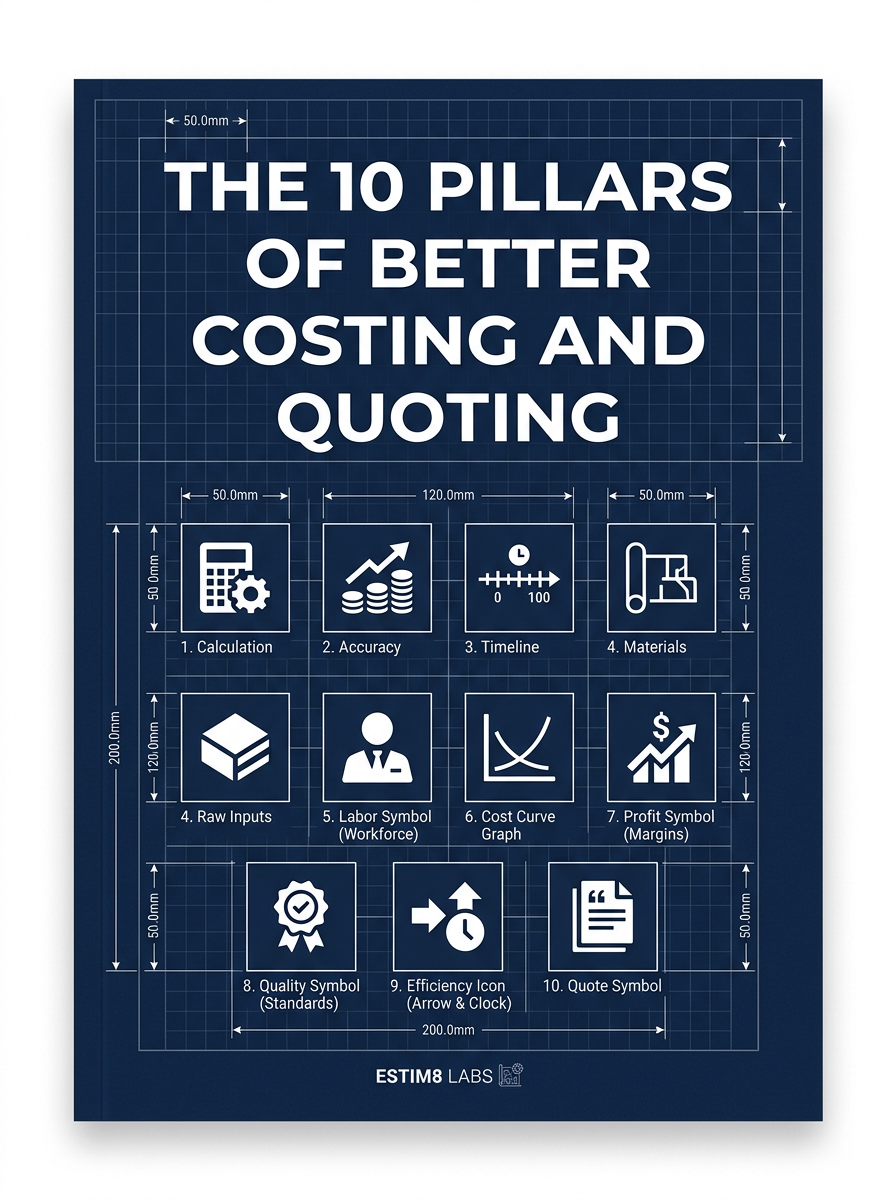
The 10 Pillars of Better Costing and Quoting
A practical guide for owners and estimators: the ten foundations of a costing and quoting system that is accurate, controlled and protects margin, whether it runs in Excel or as a connected web app.
Practical guidance.
- 6 min read
AI-assisted takeoff: what it can and cannot do
Where AI genuinely removes manual work in takeoff, where it does not, and why review is part of the design.
- 5 min read
When to move your estimator from Excel to a web app
The signals that point beyond a spreadsheet — and why many businesses should stay in Excel.
- 4 min read
Your estimating spreadsheet is valuable IP
Years of pricing decisions live in that workbook. Here is how to protect and build on them.
- 6 min read
What to do when only one person understands your estimating spreadsheet
Key-person risk sits in the workbook, not in the software brand. Here is how to make the pricing logic usable by the whole team.
- 6 min read
Why your estimators price the same job differently (and how to fix it)
Two prices for one scope usually means two rate sources. Consistency comes from one library, not from telling people to be more careful.
- 5 min read
How to stop re-keying quantities from drawings and schedules
Re-keying is where hours go and where quantities get typed twice. Structure the takeoff so a quantity is captured once.
- 5 min read
Updating supplier prices in an Excel estimating system without breaking it
A price list update should change the library, not every quote that was typed by hand.
- 5 min read
Why Excel estimating formulas break when someone adds a row
Inserting a row should not drop a total. Structured references and locked formulas stop the classic estimating-sheet failure.
- 5 min read
One version of the truth: controlling quoting spreadsheet versions
FINAL v7 and FINAL v7 (2) are how margin leaks out of a tender. One job should have one current file.
- 6 min read
Margin drift: how small estimating errors erode job profit
Margin is not a percentage typed at the end. It erodes in waste, prelims, missed exclusions and rates that were copied forward.
- 5 min read
Quotes take days? How to get construction quotes out in hours
Speed comes from reuse: assemblies, rate libraries and a quote that is generated, not retyped.
- 4 min read
Pillar 1: Capture and encode line items accurately
A short note on pillar 1 of the costing and quoting guide, with a link back to the full text.
- 4 min read
Pillar 2: Support the way your business prices projects
A short note on pillar 2 of the costing and quoting guide, with a link back to the full text.
- 4 min read
Pillar 3: Apply rates, mark-ups and commercial rules consistently
A short note on pillar 3 of the costing and quoting guide, with a link back to the full text.
- 4 min read
Pillar 4: Handle complexity, exceptions and manual overrides
A short note on pillar 4 of the costing and quoting guide, with a link back to the full text.
- 4 min read
Pillar 5: Accommodate scenarios, variations and margin adjustments
A short note on pillar 5 of the costing and quoting guide, with a link back to the full text.
- 4 min read
Pillar 6: Check, flag and approve unusual results
A short note on pillar 6 of the costing and quoting guide, with a link back to the full text.
- 4 min read
Pillar 7: Configure quotation presentation for your clients
A short note on pillar 7 of the costing and quoting guide, with a link back to the full text.
- 4 min read
Pillar 8: Connect quoting with the rest of the business
A short note on pillar 8 of the costing and quoting guide, with a link back to the full text.
- 4 min read
Pillar 9: Turn quoting data into business insight
A short note on pillar 9 of the costing and quoting guide, with a link back to the full text.
- 4 min read
Pillar 10: Use AI-assisted information processing with review
A short note on pillar 10 of the costing and quoting guide, with a link back to the full text.
Let’s solve your estimating problem.
Book a discovery call or get in touch. Attach your current spreadsheet and we'll tell you what we'd keep, fix and automate.
We typically reply the same business day. Fixed-price quotes after scoping. Your files stay confidential.